Trainers, Then Taps: The Run Club That Ends at the Bar
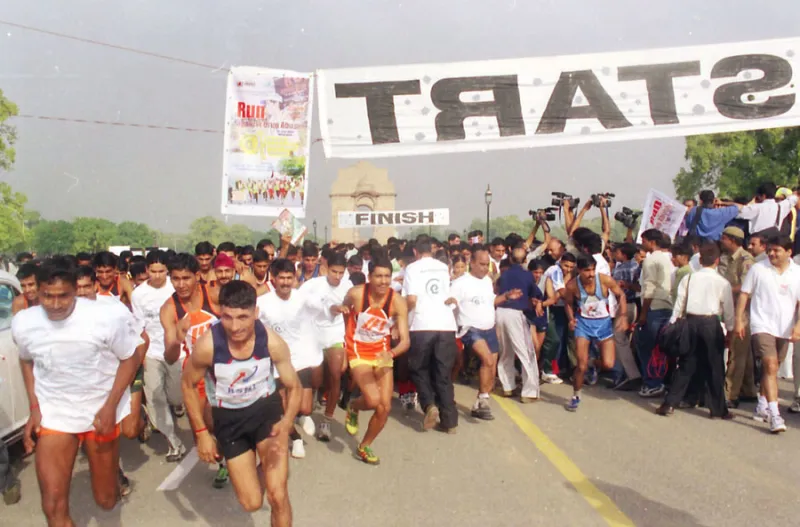
Photo: Government of India, GODL-India, via Wikimedia Commons
It is 7.12pm on a Thursday in a city centre that has already clocked off. Outside a pub, a small crowd in fluorescent trainers is doing that awkward pre-run shuffle: stretching a hamstring, checking a watch, pretending not to be nervous. Five minutes later they are gone, a loose ribbon of Lycra and chatter disappearing down a side street. Twenty-eight minutes after that, they are back — pink-cheeked, slightly damp, and ordering whatever is on the middle tap.
This is the run club in 2026: less elite athletics, more mobile social club. The distance is often a friendly 5K. The pace is whatever keeps the group together. The finish line is usually a bar stool. And for a lot of young urbanites, it has become the most dependable way to meet people without the pressure of a dating app, a big night out or another painfully polite networking event.
The finish line is a bar stool
The formula is almost aggressively simple. Turn up. Run a bit. Do not take it too seriously. Repair to the pub. Repeat next week. But the simplicity is the point. Run clubs have discovered what pubs have known for centuries: people need a reason to be in the same room, and a shared activity is often better than a shared table.
A 5K gives the evening a shape. It creates a natural beginning, middle and end, plus a reliable conversation starter that is not the weather. You can ask someone about their route, their shoes, the hill at the halfway point. You can admit you are terrible at running. You can walk for a minute without being exiled. Then, when the endorphins have done their work, the pub provides the soft landing: a place to sit, a place to talk, a place to be a bit of a mess in good company.
The result is a social scene that feels refreshingly low-stakes. No one is demanding a personal best. No one is asking you to commit to a five-a-side league or a book club you will quietly abandon by February. The deal is weekly, informal and pleasantly repeatable. That is probably why it has stuck.
The unwritten rulebook
Like any good British social ritual, the run-club-to-pub scene runs on a strict set of rules that nobody has written down but everybody somehow knows.
First: nobody gets dropped. Or at least, nobody gets dropped without a plan. Groups often split by pace, with a back marker who is officially allowed to be slow and unofficially expected to be excellent company. Second: one earphone out. You are not training for the Olympics; you are in a mobile social space. Third: the pub order is not a competition. A pint, a lime and soda, an alcohol-free lager or a packet of crisps are all equally valid finishes. The drinking is part of the ritual, not the entry fee.
There is also an unspoken understanding about conversation. Run clubs are not speed-dating with a warm-up. They work because the flirting is not the point. People arrive solo, in pairs, in scrappy groups of friends. They talk about shoes, routes, work, the state of the pavement outside the station. Romance can happen, but it is not the organising principle. That makes the whole thing feel unusually relaxed — and, for many people, unusually appealing.
Quirky clubs, serious social glue
The scene is varied enough to resist a single label. At one end, there are the old-school hash house harriers, a running-and-drinking tradition with roots going back to 1930s Malaya and a certain British knack for turning exercise into a pub crawl with a dress code. At the other, there are newer clubs that describe themselves, half-jokingly, as ‘a run club for people who hate running’. Some finish at a micropub. Some finish at a coffee shop. Some finish at a community centre with a crate of alcohol-free beer and a playlist.
In London, you will find groups that meet outside a station, run a loop of the park and take over a corner of a pub by 8pm. In Manchester, Leeds, Bristol and Glasgow, the pattern repeats with local variations: a Sunday reset run that ends with coffee, a midweek plogging club that picks up litter as it jogs, a queer run club that has become as much a support network as a fitness group. The details differ, but the mood is consistent. It is less ‘sports club’ and more ‘neighbourhood with a pulse’.
Some clubs lean into the pub finish with proper commitment. They book the back room. They print route maps. They have a WhatsApp group that is 20% logistics and 80% nonsense. Others keep it deliberately loose: a time, a place, a vague promise that nobody will be left behind. Both versions work, because both versions understand that the run is the pretext, not the whole point.
Why trainers beat apps
Part of the appeal is fatigue with the usual ways of meeting people. Dating apps can feel like admin. Big nights out can feel expensive and performative. Even friendship can start to feel like another task to optimise. A run club offers something different: regular, low-cost, face-to-face contact with a built-in alibi. You are not there to be interesting. You are there to move. The conversation follows.
There is also the simple fact that trainers are a brilliant icebreaker. They signal that you are willing to be a bit rubbish in public. They suggest you are not taking yourself too seriously. They make it acceptable to arrive alone and leave with a new acquaintance. In a city, that is valuable currency.
And then there is the pub. Not as a destination for heavy drinking, but as a social living room. The run club has accidentally reinvented the ancient British art of the third place: somewhere that is neither home nor work, where you can stay for twenty minutes or two hours, where the atmosphere does half the social work for you. The pint is a punctuation mark. The club is the sentence.
The cool-down
The run-club-to-pub boom is not really about fitness. It is about belonging, dressed up in questionable sportswear. It is about having a Thursday that does not dissolve into another night of scrolling. It is about the small, civilised thrill of turning up somewhere alone and leaving with a plan for next week.
So if you see a flock of pink-cheeked people spilling out of a pub at 8.30pm, still in running gear, do not assume they are training for anything. They are probably just doing the most 2026 thing imaginable: getting their steps in, getting their social life in, and getting the first round in. Sweat, stout, repeat. It is not a workout plan. It is a way of living.