Shelter Skelter: The Bus-Stop Galleries Making Britain’s Commutes Worth Missing
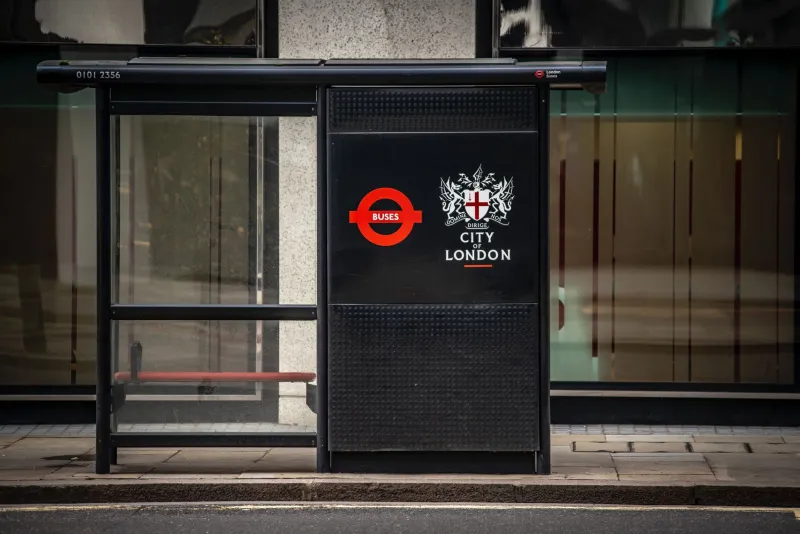
You are standing under a plastic roof, watching rain slide down the glass, wondering whether the 43 is ever coming. Then you notice it: a photograph of a tower block at dawn, taped neatly behind the timetable. No label. No ticket desk. No one asking you to sign up for a newsletter. Just a picture, a bench, and a small crowd of people pretending not to look.
Across the UK, bus shelters are quietly becoming galleries. Not the polished, sponsor-logo kind — the real thing. In Cornish villages, Glasgow suburbs, Midlands high streets and London side roads, local artists, schools and community groups are using the shelter as a display case. The work is small, weatherproof and free. The audience is whoever turns up. And in 2026, that accidental audience is turning out to be one of the most interesting things about British culture.
The captive audience
Galleries spend a fortune trying to get people to stand still. Bus shelters manage it for the price of a laminated print and a few cable ties. The deal is simple: you are already waiting, so you may as well look. There is no threshold to cross, no cloakroom, no café selling a £6 slice of cake. The art comes to you, at eye level, while you are doing something else.
That changes the work. A bus-stop exhibition cannot rely on a wall text or a mood-lit room. It has to read from the pavement in four seconds flat. One strong image. One clear idea. One object that makes a schoolkid stop scrolling. Curators who work in these spaces talk about commuter time the way other curators talk about wall space: you have roughly the length of a bus delay to make your point.
The subjects tend to be local, too. Photographs of the high street before the scaffolding went up. Portraits of market traders. Prints of estate stairwells. A poem about the night bus. A textile square made by a primary school. It is not necessarily “community art” in the soggy-bunting sense. Sometimes it is strange, funny, a bit awkward. That is the point. A bus shelter is not a taste-making machine. It is a window on the place it stands in.
Who’s hanging the pictures?
The people behind these micro-exhibitions are a mixed bunch. Parish councils. Library art groups. Sixth-form photography classes. Artist-run studios with more energy than storage. Micro-galleries that have run out of wall. The occasional local curator who has realised that the shelter outside the Co-op gets more footfall than the civic museum.
Some projects are official, with permission from the council or the transport operator. Others are more guerrilla: a set of prints, a pack of velcro, a quiet Saturday morning install. Both versions tend to follow the same rule book — don’t cover the timetable, don’t block the bench, don’t use anything that will turn into soggy confetti after a week of British weather. Weatherproof frames, laminated prints and QR codes to artist websites are standard kit.
The appeal for artists is obvious. A bus shelter is already lit, glazed, street-facing and free. It is a vitrine with a bench. You do not need an invigilator, a private view or a guilty feeling about leaving the exhibition unattended. You just need something worth looking at, and the nerve to put it where people are not expecting it.
Why glass beats the white cube
There is a reason this format feels more democratic than a lot of official public art. You do not have to know anything to look at it. You do not have to dress for it. You do not have to be quiet. Schoolkids can point at it. Someone can mutter “that’s my auntie’s road” and mean it. The art is not asking to be admired. It is just there, in the middle of the day, among the litter and the bus timetables.
It also fits the way we actually use cities. Most of us do not spend our weekends wandering between galleries. We wait. We walk. We kill ten minutes. The bus shelter catches that dead time and gives it a little texture. In 2026, when culture budgets are tight and everyone is looking for cheap ways to make places feel alive, that is not a small thing. A shelter exhibition costs less than a round of coffees and can make a whole street feel like someone is paying attention.
How to plan a bus-stop art trail
You do not need a guidebook or a special app. You need a bus route, a bit of daylight and the willingness to get off one stop early.
Pick a corridor, not a destination. Choose a road or suburb with a cluster of shelters — a high street, a coastal route, a suburban parade of shops. Art trails work best when you can walk between stops as well as ride. Check local council arts pages, community noticeboards and artist-run Instagram accounts for current projects. Some exhibitions are up for a month; some last a weekend.
Go off-peak. Mid-morning or early afternoon on a weekday means you are less likely to be blocking a shelter for someone who actually needs the bus. It also means better light for looking. Take a day ticket if you are covering a few miles, or just walk the route and use the shelters as landmarks.
Start with one good stop. You do not need to see twenty. Find one shelter with work that makes you look twice, then follow the thread. Ask at the local library or a nearby café — someone will know who hung it. Half the pleasure is the detective work.
Be a good gallery-goer. Do not touch the work, do not block the timetable, and do not photograph people without asking. If there is a QR code, use it. If there is a comments card, write something. These shows are often run on goodwill and a shoestring, and a bit of feedback goes a long way.
Build in a pit stop. The best bus-stop art trails end with a cup of tea, a corner-shop browse or a park bench. The art is the excuse; the wander is the point. A Cornish coastal route, a Glasgow suburb, a West Midlands high street — the format travels because it belongs to the place.
The fare is the ticket
None of this is precious. Bus shelters are draughty, sometimes grubby, occasionally vandalised. The work can fog up, fade or get covered in stickers. That is part of the charm. It is culture without the velvet rope, in the one gallery where the closing time depends on the timetable.
So next time the bus is late, look properly. You might see a photograph of your own street, a print that makes you smile, or something so odd you have to photograph it for a group chat. You might even miss the bus. In 2026, that feels like a fair swap.