Porch Light Reading: How Britain’s Tiniest Libraries Became the Street’s Social Glue
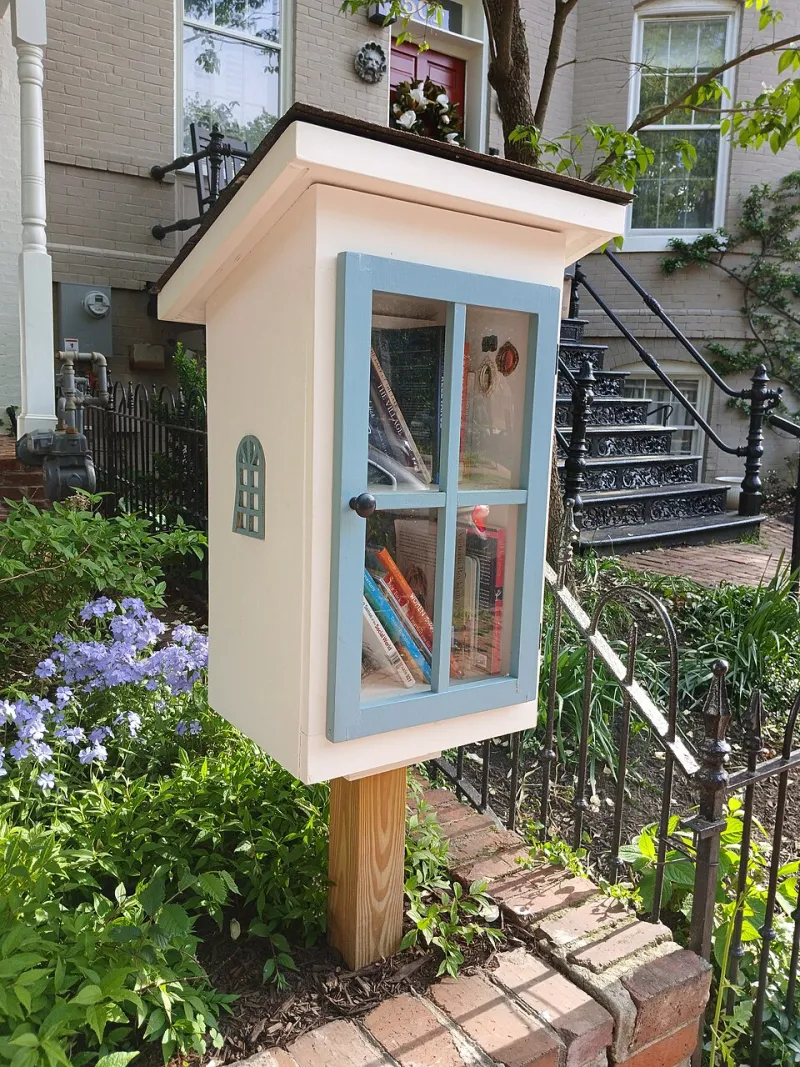
Photo: Ser Amantio di Nicolao, CC BY-SA 4.0, via Wikimedia Commons
There is a certain kind of British street where the social life happens at ankle height. Not the pub, not the park bench, not the WhatsApp group that only wakes up when a bin goes missing. It’s a small wooden box bolted to a garden wall, a repainted phone cabinet, a waterproof crate on a fence post — and it is quietly doing more for neighbourhood morale than most of us manage in a decade.
Little free libraries have been part of the UK streetscape for years, but 2026 has given them a second wind. Maybe it’s the cost of everything, maybe it’s the slow death of the aimless browse, maybe it’s simply that people are desperate for a reason to linger outside someone else’s house without it being weird. Whatever the cause, the front-garden library has become the most charmingly low-stakes social hub on the block.
The shed that says hello first
Walk past one at 7am and you’ll see the early shift: a dog walker pocketing a Lee Child, a cyclist slotting in a half-read biography, a teenager pretending not to care while definitely checking the bottom shelf for manga. Walk past at 7pm and it’s a different crowd — parents swapping parenting manuals they’ve given up on, someone leaving a note that says ‘good luck with chapter four, it gets better’, a retired teacher quietly restocking the poetry section.
What makes these things work isn’t the books. It’s the theatre of trust. You leave something. You take something. You don’t have to talk to anyone, but you are, in a small way, in conversation. The shelf becomes a noticeboard with a plot. And because it’s outside, it’s exempt from the awkwardness of knocking on a stranger’s door.
A short field guide to shelf architecture
The great British front-garden library is a masterclass in make-do-and-mend. There’s the phone-box conversion — usually a proper red kiosk with the glass replaced by shelves, found in market towns and coastal spots where BT finally gave up. There’s the old scout hut cabinet, painted a jaunty colour and mounted on a post so it’s accessible from the pavement. There’s the upcycled newspaper box, the converted bread crate, and the frankly ambitious miniature house with a pitched roof and a tiny door, which is either adorable or a planning permission headache depending on your postcode.
The best ones have a bit of personality: a laminated ‘shelf rules’ sign, a guestbook, a jar of bookmarks, a small tin of biscuits that nobody touches but everyone appreciates. The worst ones are just a soggy cardboard box with a copy of a diet book from 2003. We’ve all seen it. We’ve all walked past it.
The unwritten rules of shelf citizenship
Nobody hands you a manual, so here’s the 2026 edition. One in, one out is the golden rule — unless you’re restocking, in which case go wild. Don’t leave anything you wouldn’t lend a friend: no mouldy paperbacks, no twenty-year-old computer manuals, no books with the last chapter torn out. Respect the theme if there is one — some shelves are strictly crime fiction, some are kids’ books, some are ‘anything goes but please no Dan Brown’. And if you take the last book, leave a note — it’s the street-level equivalent of holding a door open.
The most controversial rule? Don’t use it as a dumping ground for your house move. We get it, you’re moving to Bristol and you can’t face another box. But nobody needs a 1998 AA road atlas or a broken-spined copy of Fifty Shades. The shelf is a salon, not a skip.
Route map: five to seek out
You don’t need an app to find them — just walk a residential street anywhere and look for the little painted sign. But if you’re making a day of it, here are five reliable stunners.
The phone-box library in Ryde, Isle of Wight — a proper red kiosk with a poetry shelf that punches above its weight. The front-wall cabinet in Hackney, East London — repainted every summer by the family next door, with a kids’ section that is genuinely better curated than some bookshops. The converted bread crate in Sheffield — a five-minute walk from the train station, stocked with zines and left-field fiction. The garden-gate shelf in Bristol — two shelves, one for adults and one for children, with a laminated ‘please borrow, please return’ note that has clearly been ignored for years. The community shed in Glasgow’s Southside — a proper wooden cabin with a bench next to it, because the owners know exactly what they’re doing.
Why the shelf works when the group chat doesn’t
There’s a reason these tiny libraries feel like a tonic in 2026. They’re analogue, they’re free, and they don’t require you to perform. You can engage as much or as little as you like. You can be the person who quietly restocks the children’s shelf every fortnight, or the person who just takes a thriller on a Sunday and never speaks of it again. Both are valid.
And unlike the neighbourhood Facebook group — which is 40% lost cats and 60% passive-aggressive parking — the front-garden library has a built-in civility. You can’t argue with a book. You can only take it home and disagree with it in private, which is the British way.
So next time you pass one, stop. Have a browse. Leave something behind. You might not meet your neighbour, but you’ll definitely meet their taste in fiction. And honestly, that’s a pretty good place to start.