The Fixers Next Door: Inside Britain’s Saturday Repair Café Boom
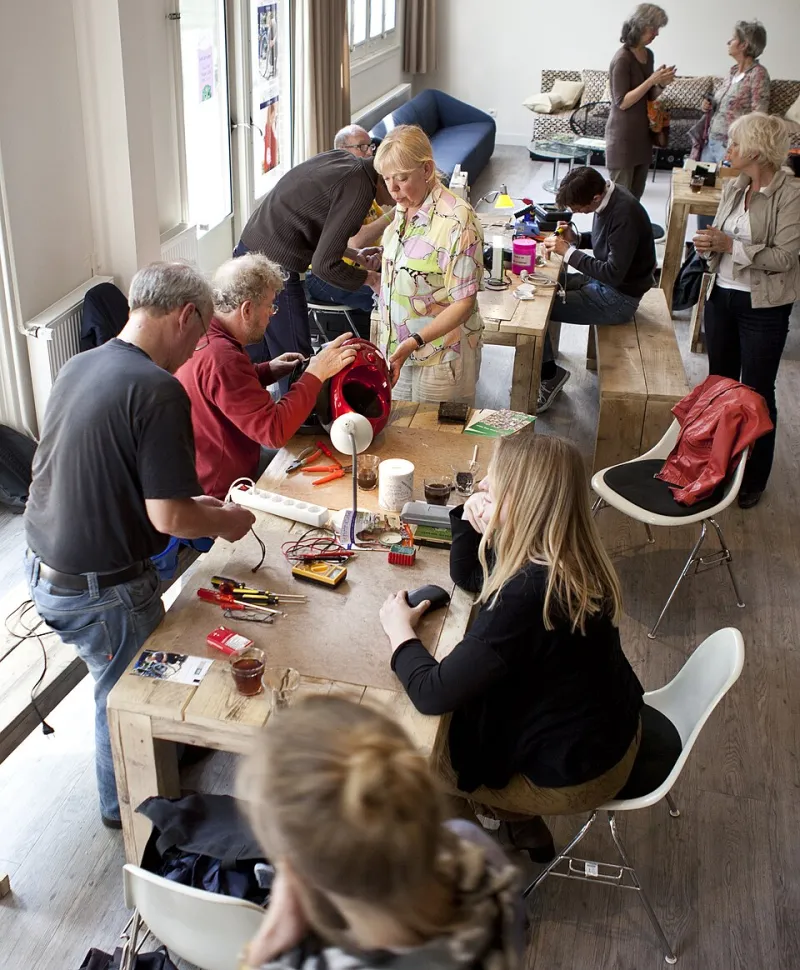
Photo: Ilvy Njiokiktjien, CC BY-SA 3.0, via Wikimedia Commons
The queue starts at 9:58am. By 10:05, the church hall in Sheffield smells of coffee, WD-40 and the particular optimism of people carrying broken things in carrier bags. A woman named Priya is holding a 1990s Roberts radio. A man called Alan has brought a toaster that ‘makes a noise like a wasp.’ A teenager is clutching a lava lamp with a look of quiet desperation. This is a repair café, and it is the most hopeful place in Britain on a Saturday morning.
The Queue at 9:58
The repair café movement has been growing quietly for years, but 2026 feels like its moment. There are now hundreds of them across the UK, from village halls in Somerset to community centres in Glasgow. The format is simple: you bring something broken, a volunteer tries to fix it, and you leave with a working object, a cup of tea and, often, a new friend. It is free, though donations are welcome. The waiting list is usually longer than the queue.
Priya is a first-timer. ‘I saw a poster in the library,’ she says. ‘I thought, I’ll give it a go. My mum had this radio for years. It still lights up, it just doesn’t make any sound.’ She is nervous, as if the radio might be judged. It won’t be. At the front desk, a volunteer named Bev takes the radio, writes a ticket, and says, ‘We’ll do our best.’ That’s the official motto, and also the unofficial one.
The Bench of Second Chances
Alan, 74, is a retired engineer and a veteran mender. He has a toaster open on the bench in front of him, its innards exposed like a small, domestic surgery. ‘Nine times out of ten, it’s the element,’ he says. ‘People chuck them away because they think it’s gone. But it’s usually one part. One part.’ He finds the fault in four minutes, replaces a wire, and plugs it in. The toaster hums. It doesn’t sound like a wasp. It sounds like toast.
Across the room, a woman is learning to solder. A man is fixing a lamp that his grandmother bought in 1968. A child is watching a volunteer take apart a remote-control car with the intensity of a surgeon. The hall is full of small, careful acts of attention. Nothing here is disposable. Everything gets a second look.
The Politics of a Broken Kettle
There is a quiet politics to all this. The UK throws away thousands of tonnes of small electricals every year, and repair cafés are a small, stubborn refusal of that. They are not just about saving money, though that helps. They are about skills, about memory, about the idea that a thing can be worth keeping. ‘It’s not just the toaster,’ says Bev. ‘It’s the story. People bring things that belonged to their parents. They bring things they saved up for. They don’t want to let them go.’
The volunteers are not preachy about it. There is no lecture on sustainability, no guilt about the landfill. There is just a bench, a toolbox, and a cup of tea. But the effect is the same: people leave with a working radio and a slightly different relationship to the things they own. ‘I’ll think twice before I bin something now,’ Priya says. ‘I didn’t know you could just... fix it.’
The Plug-In Moment
At 11:47am, the Roberts radio comes back to life. It takes a while to warm up — it is a 1990s radio, and it has opinions — but then a voice fills the hall. It’s a local station, playing something with a saxophone. Priya laughs. She actually claps. The volunteer who fixed it, a softly spoken man named Colin, looks almost embarrassed. ‘It was just a loose connection,’ he says. ‘Nothing special.’ But it is special. It is the whole point.
The queue is still there at noon. The toaster is making toast. The lava lamp is bubbling. The teenager is smiling. And in a church hall in Sheffield, a small, quiet revolution is happening one broken thing at a time. Bring something next Saturday. See what comes back to life.